When you save a room with a chrome table or a silver tray, the metal is rarely the only thing you remember. You remember the wood grain caught in its surface, the pale side of a linen sofa, or a strip of window light along the table edge. The metal gives that scene one crisp point of light.
The questions change once you picture the piece at home. Would it look too bright beside your white wall and glass table? Would a chrome lamp make a living room full of wood furniture feel like a different room? You may like silver, yet still hesitate because you do not want the whole space to tip into a colder mood.
Start by looking at what the metal reflects, not just the color of the finish. Chrome and silver change with the materials and light around them. They can enter as a narrow line on a handle, a small pause on a tray, or the visual anchor of a side table.
Will silver make the room feel cold?
Metal can feel unfamiliar at home when too many reflective surfaces meet at once. Bright chrome, a glass top, white overhead light, and a cool gray wall can all pull the eye in different directions. A small metal detail reads differently beside linen, wood, or a matte wall, where the light has somewhere softer to land.
You do not need to decide whether your home is a "chrome home" before you begin. Look at the surfaces that already catch light and the materials beside them. A silver pull on a wood cabinet, a small wall light beside a fabric bed, or a low tray on a stone counter lets you try metal within one contained scene.
Chrome and silver are about reflectivity before color
ELLE Decor's 2026 trend coverage places the return of chrome and silver alongside natural textures and softer materials. That context is useful because it moves the decision away from choosing a fashionable color. The same silver finish can play a different role depending on what it reflects in the room.
Homes & Gardens describes Shea McGee's silver styling through layered interiors with wood, stone, and soft textiles. That does not make silver the better finish. It gives you a useful question: how much shine does this surface have, and what materials will sit close enough to shape the way it reads?
Chrome can give a room a clearer reflection, while brushed nickel or softened silver can hold a quieter surface. Neither finish works in isolation. In a room full of glass and bright lighting, reduce one reflective plane. In a room led by matte walls and fabric, a slim metal detail may give the space a needed point of definition.
The Metal Reflection Balance
Before you decide from a product image, work through the checks below. Separating finish, area, surrounding material, light, touchpoint, and room mood can turn "I like this" into a choice you can place in a real room.
| Decision axis | Check first | Signal that it is taking over | How to lower it |
|---|---|---|---|
| Finish | Is it mirror-bright, or does it have a brushed or satin grain? | White light, glass, and reflective surfaces gather in one view. | Lower the sheen or reduce the metal area. |
| Area | Is the metal a pull, a light, a tray, or a table? | A large metal plane takes every line of sight in the room. | Begin with a narrow line or one object. |
| Surrounding material | Are wood, linen, stone, or matte paint close by? | The metal is surrounded by glass, glossy tile, and cool color. | Put one matte textile, wood, or stone surface directly beside it. |
| Light | Does it receive daylight, warm lamp light, or bright ceiling light? | The metal alone looks white and sharp. | Use diffused light or a shaded fixture to divide the scene. |
| Touchpoint | Is it a handle you see every day or a tray you notice when you pause? | Small metal details repeat along every path through the room. | Keep the first visible detail in one place. |
| Room mood | Should the room read calm, modern, or urban? | Form, color, and shine all contrast at full strength. | Raise only one contrast axis. |
The table is not asking you to make every metal detail timid. It helps you find the axis that is already strong, then quiet the rest of the scene. If the finish is crisp, keep the area small. If you want a large side table, let the wall and rug around it stay calm.
Start with a small metal line
Handles and lighting are an easy place to begin because they change the outline of a room without replacing the room itself. Silver pulls on warm oak or walnut cabinetry leave the wood surface in charge while sharpening the point where your hand lands. A small wall light beside fabric or a matte wall can set the direction of light without turning the whole wall into a statement.
Keep the repetition inside one scene. In a kitchen, that might mean pulls and one small light. In a bedroom, it might mean a wall light and a tray beside the bed. When chrome handles, silver frames, steel shelving, and mirror edging all appear at once, each line asks for attention at the same scale.
Choose the object and its surrounding materials together
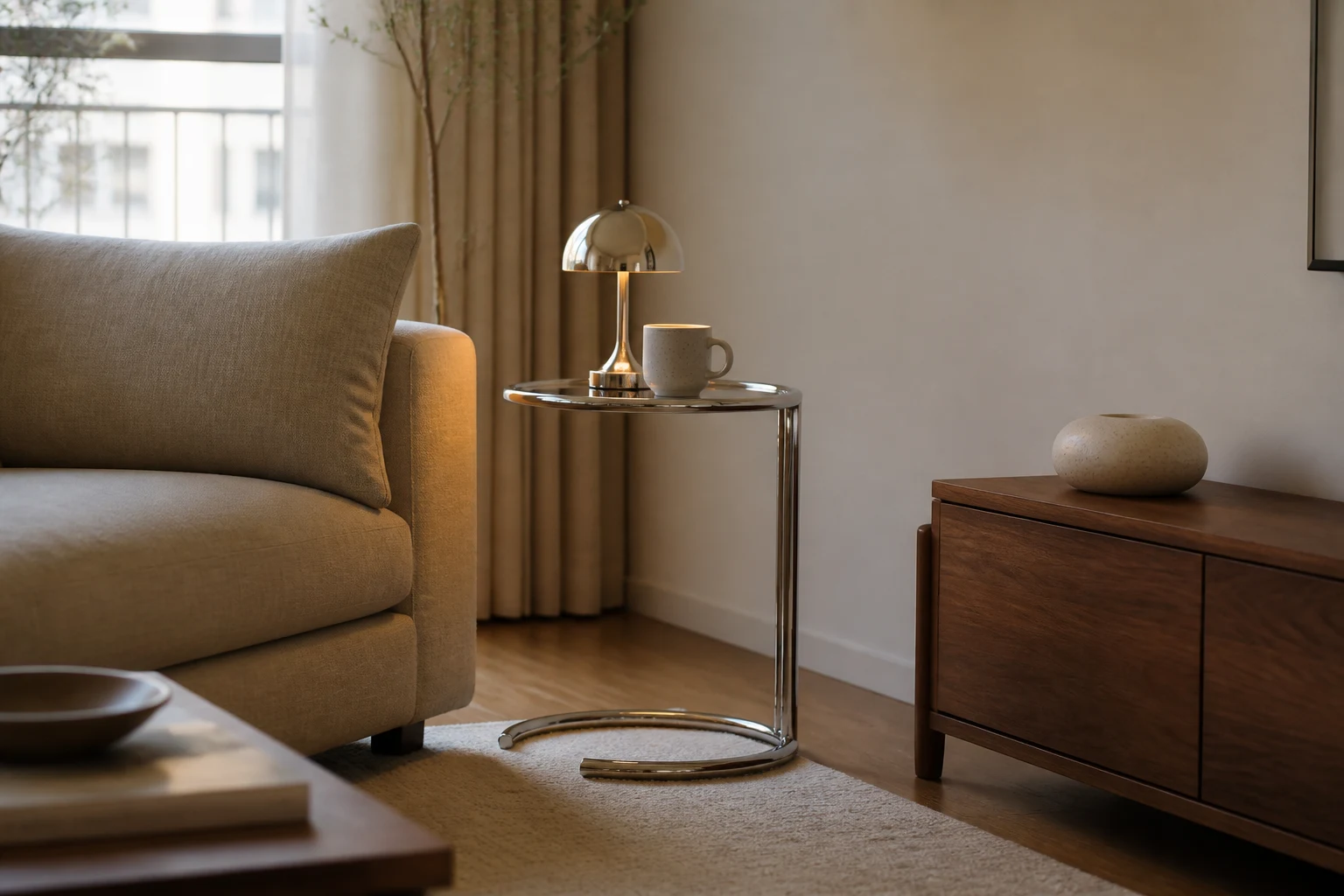
A side table or a substantial tray reflects more than a small handle. It picks up the sofa color, the texture of the rug, the window light, and the floor tone. When you choose a metal object or piece of furniture, look at the material beside it as part of the same decision.
A chrome side table beside a linen sofa can stay lively while the sofa and rug settle the scene. A silver tray on a walnut console can catch the depth of the wood and remain as one point of light. In both cases, metal does not need to become the theme of the whole room. It reveals the texture that was already there.
Large metal furniture also needs quiet space around it. A busy rug below, glossy storage behind, and strong lighting above can leave the eye nowhere to settle. If the metal piece is the anchor, keep the nearest two planes quieter.
Keep matte planes next to cool metal
Chrome and silver draw attention because their surfaces return light. Matte materials give that reflection a calmer setting. The fine texture of linen, the lower sheen of wood, the muted face of cream stone, and a broad painted wall can hold the metal's clarity without competing with it.
This is not a formula for painting every room warmer. Walnut or pale oak, cream stone or gray stone can all work when the surrounding planes do not return light at the same intensity. The same idea helps in bathrooms, where the faucet is only one part of a scene made by the mirror, counter, and wall.
If your room already has bright tile, glass, and high-gloss storage, you do not need to avoid metal. A quieter finish such as brushed nickel, or a single concentrated metal area, can be enough. In a room led by wood and fabric, a small chrome lamp or silver object can introduce a clean break in the texture.
Raise one contrast axis at a time
To make chrome or silver feel more contemporary, do not raise every contrast at once. Choose one first: a black frame, a blue wall, a sharper silhouette, or a mirror-like finish. Let the rest of the room follow its existing tone. The metal can look modern without pushing the whole scene too hard.
An entry with pale oak flooring and matte walls may only need one black frame and one chrome light. In a bedroom or home office with a blue wall, a brushed nickel lamp and cream textiles can separate the textures. Cool color and cool metal can sit together when fabric and wood still have room in the view.
"More modern" does not have to mean adding more decoration. Contrast directs the eye. When one point becomes crisp, another part of the room needs to step back.
Read the surroundings in a reference, not just the metal
When you save a chrome or silver reference, look at three things together: where the metal has the most surface area, which material sits directly beside it, and how light moves across that surface. Those details make a preference easier to describe.
"I like silver handles" becomes "I like a thin silver line on walnut cabinetry." "I like a chrome table" becomes "I like a table that reflects one small point of light beside a linen sofa." The conversation can move beyond the name of the finish and toward the setting that lets it work.
Chrome and silver do not have to make a home feel cold in an instant. Begin with a narrow line, one object, or one quiet piece of furniture, then decide what should stay nearby. The metal can belong to the room when it makes the existing light and materials easier to see.