Dark wood gets heavy under specific conditions
People who like dark wood often stop at the same worry. Walnut storage, a dark wood dining table, or a deep wood wall can look beautiful in a reference image. But once it enters their own home, will the room look narrow, dim, or heavy?
That concern is reasonable. Dark wood changes the visual weight of a room. It does not recede like pale oak or white finishes. It steps forward. Used well, though, that weight becomes depth instead of pressure. The issue is not the color. The issue is the standard you use to place it.
Dark wood is not a material to judge as simply good or bad. First look at where it appears, how much of it is visible, and which bright surfaces remain around it.
The moment dark wood makes a room feel heavy is not the moment you choose a dark color. It happens when the same tone repeats across broad surfaces, the white wall or pale floor that should catch light disappears, and the furniture forms also become thick.
A walnut dining table can become a strong center. But if the floor, built-in wardrobe, and upper kitchen cabinets all carry a similar dark tone, the story changes. Each element may be beautiful on its own. Inside one room, they all start speaking from the front.
Before choosing dark wood, decide where the lead voice will be. If the floor is the lead, the wall and large storage should stay quiet. If wall storage is the lead, the floor and table should step back. When every wood surface speaks at the same volume, the home becomes heavier rather than deeper.
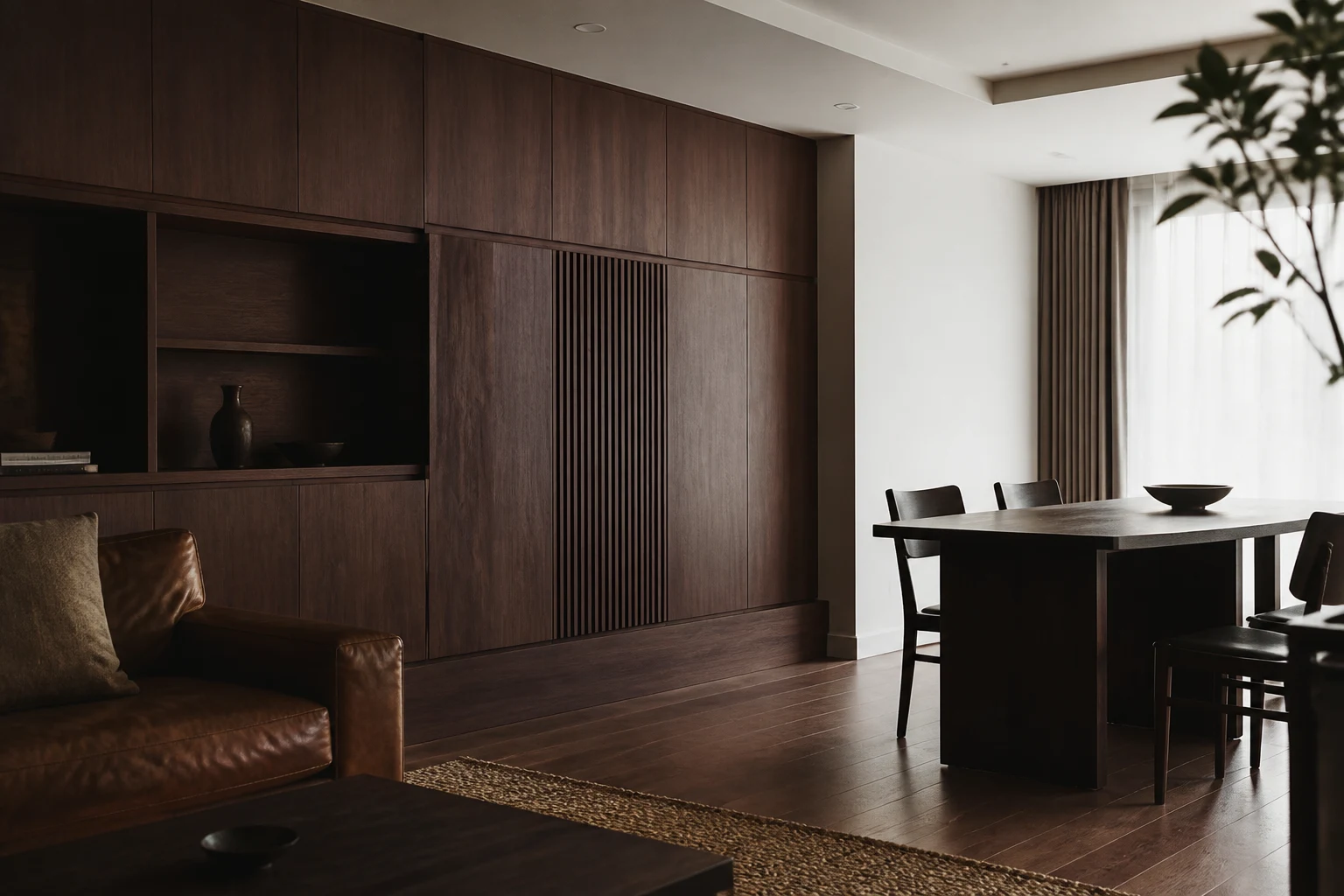
The dark wood depth matrix
Before a consultation, fill in this table first. Collecting attractive references matters less than deciding what becomes dark and what stays light.
| Criterion | Question to ask first | Signal that it is getting heavy | Adjustment that creates depth |
|---|---|---|---|
| Area | How many large surfaces will carry dark wood: floor, wall, storage, or kitchen cabinetry? | Three large surfaces are all dark. | Let one surface lead and keep the others lighter or quieter. |
| Light | Is there still a bright surface that receives daylight during the day? | The window wall, ceiling, and main wall are all dark. | Keep the window area and ceiling-adjacent surfaces bright. |
| Contrast | Does the wood have room to breathe beside it? | Dark wood, black details, deep fabric, and a dark wall merge into one block. | Create distance with ivory, light gray, metal, or pale fabric. |
| Grain | How strongly does the wood grain show? | A bold grain repeats across a large uninterrupted surface. | Use strong grain on smaller areas; keep broad areas matte or quieter. |
| Form | How high and thick are the furniture pieces? | Tall cabinets, thick tops, and closed bases stack together. | Mix in raised legs, lower storage, and thinner lines. |
The goal of the matrix is not to narrow your taste. It is to make dark wood easier to live with over time. Depth does not come from using more dark color. It appears when dark surfaces and bright surfaces each have a clear role.
When one large surface leads the room
Use these references to see whether a dark wood surface still leaves enough bright wall, floor, and fabric around it.
Use one large surface and repeat smaller accents
At home, large surfaces are the parts you keep seeing for years: floor, walls, kitchen cabinets, and built-in storage. If one of them is dark wood, the room already has enough character. Adding the same tone everywhere can make the room feel pressed down before it feels unified.
Smaller surfaces can repeat the tone more safely. Think of table legs, shelves, frame edges, thin wood near door handles, or a small stool. When the tone returns two or three times in short glances, one large wood surface no longer feels isolated.
A good dark wood interior does not force every wood to match. It chooses one central tone and lets the rest support it. The more important decision is not whether the wood tones match. It is which wood leads the room and which wood stays in the background.
Choose what will stay light first
If you want to use dark wood, decide what will stay light before deciding what will become dark. The ceiling, wall near the window, view at the end of a hallway, and large wall behind the sofa all hold the room's sense of brightness for a long time.
If the floor is dark, keep the walls and ceiling light. If you choose dark wood wall storage, avoid making the floor too red or too deep. If the lower kitchen cabinets are dark, let the upper cabinets or countertop open up in a lighter tone.
When the bright surfaces are protected first, dark wood does not cover the room. It can make the brighter areas sharper and give the eye a place to rest.
References for the surfaces that stay light
Compare how window light, bedding, rugs, and wall planes remain visible beside dark wood.
When the grain is strong, reduce the color load
Dark wood is not only a color. Grain, sheen, and surface texture all appear together. A bold walnut veneer can feel more active, while a matte surface with calmer grain feels quieter even in a similar tone.
If a strong grain covers a large surface, the pattern can become louder than the color. In that case, simplify the surrounding finishes. Reduce wallpaper patterns, avoid busy fabric, and keep metal or stone finishes to one or two types.
A quieter dark wood can be used across a broader area with less tension. Then you can bring in more surface difference: matte walls, pale fabrics, or thin metal lines. Those textures keep dark wood from sinking into one flat mass.
In a small home, start low
In a small home, dark wood is easier to start with below eye level than on a tall wall. A dining table, low media unit, bed frame, or small shelf can anchor the room without blocking the whole view.
By contrast, a dark built-in cabinet reaching the ceiling, a full dark wall finish, or dark upper kitchen cabinets can become demanding in a small room. If you need them, keep handles and lines thin, leave the surrounding walls and floor lighter, and make sure light still reaches a visible surface.
A small home does not have to give up dark wood. It only needs to control the height and area that dark wood occupies.
Starting dark wood at a lower height
In smaller homes, dark wood is often easier to handle in low furniture than across tall walls.
In consultation, talk about position before color names
When you bring references to a consultation and say you like a walnut mood, the conversation starts too broadly. Add one more sentence and it becomes much clearer.
I want dark wood on the dining table and low storage, not across the whole floor.
The lower kitchen cabinets can be dark, but I want the upper cabinets and wall to stay light.
I prefer a quiet matte wood over a large, bold grain.
These sentences do not reduce your taste. They reduce the area the designer has to guess. When you talk about position, area, and the parts that should stay light, estimates and design drafts can move in a more realistic direction.
Depth comes from roles, not darkness
Dark wood changes a room quickly, so it needs care. But care does not mean avoidance. Well-placed dark wood can give a bright room a center of gravity and make white walls and pale fabrics look clearer.
The core decision is simple. Before adding more dark wood, decide which surface creates depth and which surface preserves light. When one dark surface is clear, enough bright surface remains, and the resulting forms do not fight each other, dark wood feels closer to stability than to heaviness.
Choosing dark wood is not really choosing a color. It is choosing where the eye should settle inside the home.